
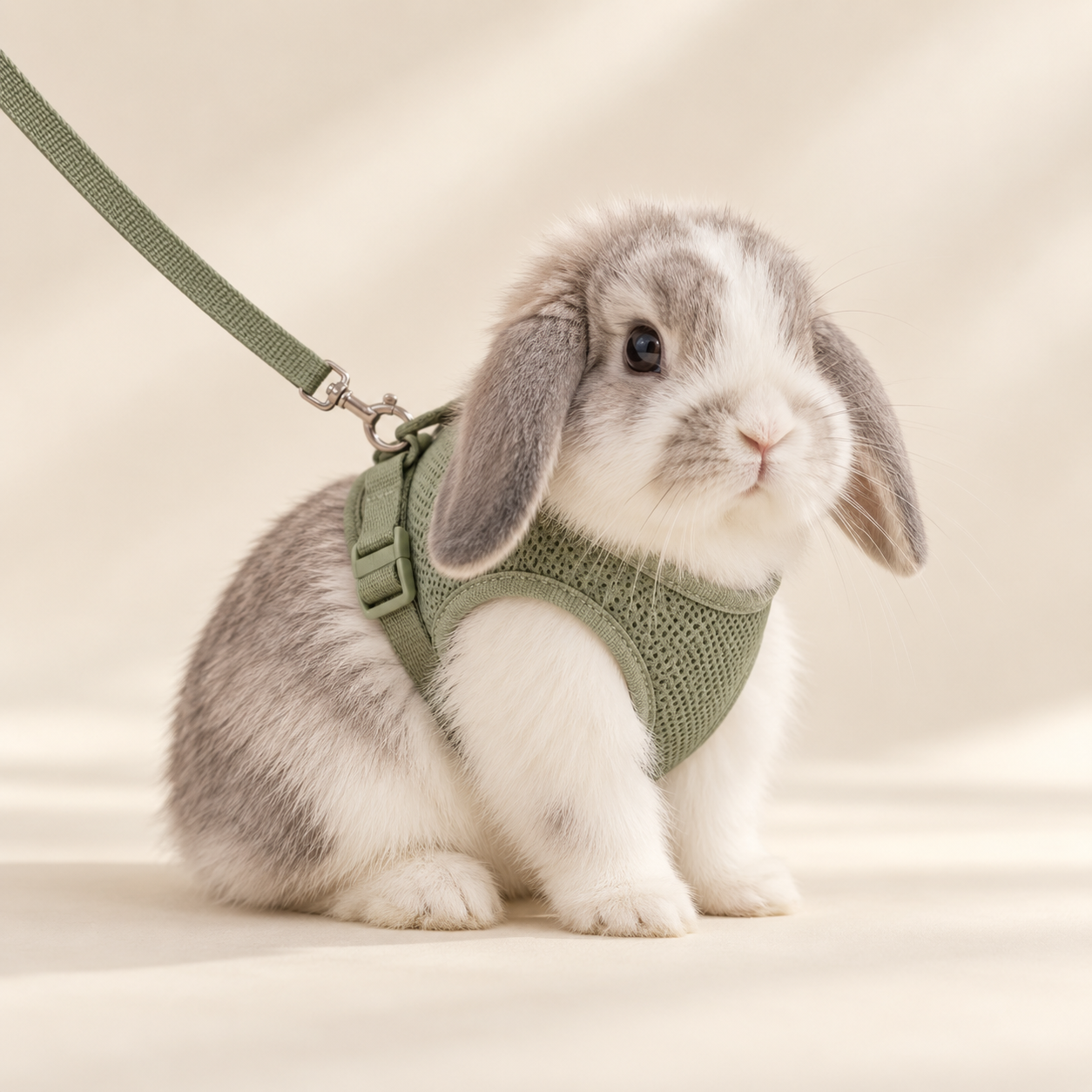
Start with the right question
Before choosing a harness, ask whether a walk truly meets your rabbit’s needs. Rabbits need movement, exploration and places to retreat, but not necessarily an outing on a leash. Rabbit welfare organisations highlight risks of panic, escape and injury associated with harness use. A spacious, secure enclosure is an option to favour for exercise. This guide cannot turn a walk into a risk free activity. It helps you understand limitations, decide against an outing when appropriate and protect your companion’s ability to choose. A rabbit who enjoys life indoors is not missing an essential experience simply because they do not go for walks.
Rabbits do not walk like dogs
Your rabbit moves at their own pace, stops to investigate and may suddenly leap when frightened. They do not naturally understand leash tension and must never be pulled along a route. Their skeleton is fragile and a panic response can have serious consequences. A vest does not remove that risk. Avoid street walks, areas with dogs and outings where the environment cannot be controlled. If your aim is simply to offer grass and new smells, a suitable enclosed exercise area may meet that need more directly. Do not expect calm behaviour at home to predict an equally calm reaction in an unfamiliar outdoor place.
Consider temperament and health
A rabbit who freezes when touched, tries to escape or dislikes handling is not a suitable candidate for harness familiarisation. Respect this information rather than trying to overcome it at any cost. Talk to a rabbit experienced veterinarian about health, mobility and preventive care before considering outdoor access. Vaccination and other precautions should reflect your location and local risks. An unwell, recovering or highly stressed rabbit mainly needs a stable environment. Age and a quiet appearance cannot reliably predict an outdoor response. Consider your individual companion’s behaviour over time instead of using a general description of a breed as a reason to proceed.
Choose a genuinely safe space
Inspect the area before bringing your rabbit: boundaries, ground surfaces, plants, garden chemicals and other animals all matter. A family garden is not automatically safe. Look for gaps beneath barriers, holes and objects that could cause injury. Provide shade, water and a familiar retreat. An enclosure must also address predators and prevent escape above or below its boundaries where relevant. Stay present while your rabbit explores. Travel to the chosen area should take place in an appropriate carrier, not with your rabbit dangling or walking at the end of a leash. Prepare the whole environment before opening the carrier door.
Introduce the vest without pressure
If you consider familiarisation after assessing the risks, start indoors on a non slippery floor. Place the vest nearby and allow your rabbit to investigate without fastening anything. A later session might involve brief voluntary contact and, only if accepted, a very short period of wear. Do not combine first discovery, fitting and an outdoor trip on the same day. Stop if your rabbit struggles, freezes or tries to bite the accessory. A treat should not be used to keep an animal in a situation they are enduring. It is entirely acceptable never to progress to the next stage or to decide the vest is unsuitable.
Check fit before every use
Read exact dimensions and the supplier’s fitting guidance before selecting a size. Do not rely solely on a dwarf rabbit label: rabbits of similar weight may have different body shapes. A vest must not restrict breathing or allow escape when a rabbit backs away. Inspect closures, stitching and attachment points carefully. An approximate measurement or a fit that seems almost right is insufficient. If you cannot obtain a comfortable, reliable fit, do not use the harness. Never substitute a collar and never tether your rabbit to a fixed point. Keep all handling gentle and stop the fitting process when your companion becomes distressed.
Recognise signs of distress
Prolonged stillness does not necessarily indicate relaxation. Look at posture, breathing, eyes and the ability to explore normally. Repeated escape attempts, sudden agitation or refusal to move are reasons to end the session. Do not try to reach a planned time target. Remove the vest calmly in a secure area and let your rabbit return to a familiar retreat. After a panic response, check that movement and appetite remain normal; any concern about injury needs veterinary advice. Judge welfare through the animal’s behaviour rather than a successful photograph. If you are unsure whether a response is comfortable, choose the more cautious option and stop.
Plan for a calm return
Even a short introduction may be tiring for a rabbit experiencing new smells and sounds. Prepare a comfortable carrier and the option to return immediately. Avoid heat, hot ground surfaces, strong wind and very noisy periods. Do not allow your companion to eat unknown plants or treated grass. Back at home, offer familiar water and hay and watch their behaviour. An outing that causes a lasting change in appetite or routine should not be repeated. The familiar environment is an important source of security. Keep the return quiet rather than adding another new experience or a long handling session immediately afterwards.
Choose enrichment that suits them
Your rabbit can enjoy a rich life without leash walks. A protected indoor space, suitable tunnels, movable toys and an accessible hideout already provide many opportunities to explore. Our harness vest is presented with these limitations; our wooden hideout may complement a resting space when its dimensions are suitable. Check specifications before buying and seek advice when needed. Sometimes the best choice is to leave an accessory unused. Preserving movement, respecting refusals and offering a safe environment matter more than achieving an outing through stress. Let your companion’s needs shape the activity and keep enjoyable, familiar alternatives available every day.
Further reading: general guidance from Rabbit Welfare Association & Fund and House Rabbit Society. This guide does not replace individual advice from your rabbit veterinarian.
Rabbit Welfare Association & Fund · House Rabbit Society